Writing
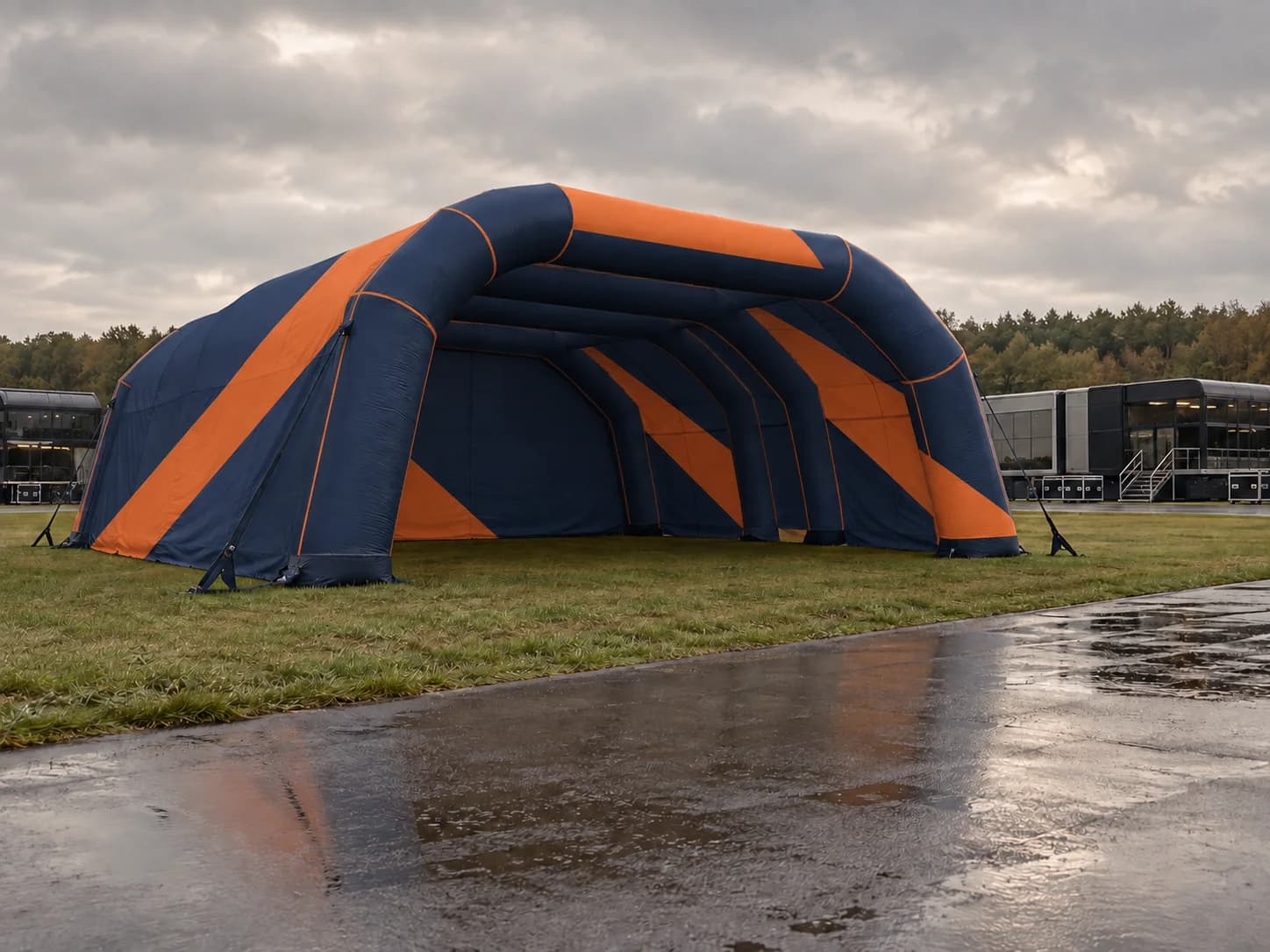
The product in the photograph was never built
A buyer wants to see their own livery on a structure that will not exist until they order it. So it gets built in software instead.
Axion UK sells sealed inflatable event structures. The entire outer surface of one is printable, which is the whole sales pitch — a buyer does not want a tent, they want their tent, in their livery, at their event.
That is also the entire photography problem. The tent in the buyer's head does not exist. It will not exist until they order it, and it cannot be photographed before then, because photographing it means manufacturing it.
What the old answer costs
The conventional fix is to shoot the range once in a neutral finish and let the buyer imagine the rest. It fails for a specific reason: a printed structure does not look like a white structure with a logo added. The print wraps a curved, inflated surface. It catches light differently along the seams. A flat mockup laid over a photograph reads as a flat mockup laid over a photograph, and the buyer — who is usually a marketing lead spending a serious budget — can tell.
The other fix is to build and shoot one per customer. Some manufacturers do it. It means a production run, a location, a crew and a weather window for an asset that will be used in one pitch.
What we did instead
Modelled the structures once, accurately. This is the part that decides everything downstream. Every hour spent getting the geometry right — the real proportions, how the fabric tensions when it inflates, where the seams actually fall — is an hour that never has to be spent again. Every hour saved here comes back as a lifetime of visuals that are subtly wrong in the same way.
Set the materials up as a swap. A new brand application is a texture change, not a new production. That is the whole economic argument: the first render is expensive and every one after it is nearly free.
Rendered motion, not just stills. The animations show a structure inflating, standing, and being walked through. A still answers "what colour is it". A buyer is trying to answer different questions — how big is it really, how long does it take to put up, what does it feel like to stand inside. Those are questions about time, and only motion answers them.
Carried the same renders into the site. What a buyer sees while browsing is what the sales team sends them afterwards. When those are made by different people at different times they stop matching, and a buyer who notices the mismatch starts wondering what else is approximate.
The thing that surprises people
CGI is usually sold on looking better. That is not why it wins here.
It wins because the cost curve inverts. Photography costs roughly the same every time you need a new one; the second shoot costs what the first did. A render library costs a great deal once and then approaches zero. Somewhere around the fourth or fifth variant the lines cross, and after that the gap only widens.
A brand that needs one image should hire a photographer. A brand that needs the same product in forty liveries — or in a livery that has not been designed yet — is not really buying images at all. It is buying the ability to produce them on demand.
What I would tell a manufacturer considering this
Spend the budget on the model, not the render. The render is a setting. The model is the asset, and it is the thing you still own in three years. A cheap model rendered beautifully is a beautiful picture of the wrong product.
Send real material samples, not a colour code. How a fabric behaves in light is most of what makes a render believable. A hex value tells us almost nothing about a coated PVC surface at a low sun angle.
Decide what the customer is trying to picture. Scale, interior, setup time, crowd flow — each of those implies a different shot. "Make it look good" implies none of them, and produces something that looks good and answers nothing.
Ask for the source files in the contract. Ask whether a new colourway is a day or a new project. If the answer is a new project, the thing being sold is images, not a system, and the cost curve will never bend.